
DF Malan High School became DF Akademie — but the initials of the man it supposedly wanted to leave behind remain firmly above the door
There is something deeply ironic about the renaming of Bellville’s former DF Malan High School to DF Akademie.
The school has gone to considerable lengths to distance itself from Daniël François Malan, the man after whom it was named and whom South Africa’s Supreme Court of Appeal described as one of the principal architects of apartheid. The court ultimately upheld the governing body’s decision, finding that the old name was fundamentally at odds with the school’s stated commitment to inclusivity and transformation.
Yet there is an obvious question that seems almost too simple to ask:
If the problem was DF Malan, why is “DF” still there?
The answer appears to be that the school wanted to remove Malan’s surname while retaining the initials that, in the context of the school’s history, have always meant D.F. Malan.
That is where the apparent contradiction begins.
The governing body argued that the old name had become an uncomfortable association with apartheid and that the school needed an identity consistent with its values of inclusivity, academic excellence and transformation. The Supreme Court of Appeal accepted that reasoning and described the decision to “purge” the school of its association with Malan’s legacy as rational and in the best interests of the institution.
But the new name has not actually purged that association.
It has abbreviated it.
A name without the surname
The original name was not merely “Malan High School”. It was DF Malan High School.
The initials were not decorative. They were the initials of the individual whose political legacy created the controversy in the first place.
Today the school’s own website identifies it as DF Akademie, while continuing to use “DF” prominently throughout its branding, documentation and communications.
That produces an extraordinary historical halfway house.
Malan’s surname has been removed because of what it represents, but his initials remain.
It raises an uncomfortable question: what exactly has been rejected?
If the answer is the apartheid-era politician, then removing only his surname while retaining his initials seems an oddly incomplete repudiation.
If the answer is merely the word “Malan”, then the school has not really confronted the historical symbolism of the name at all. It has simply modified it.
The argument becomes even more curious
The school’s name-change process was extensive.
In 2021, stakeholders were invited to suggest alternatives. Of 626 responses, 301 favoured retaining DF Malan while 325 proposed new names. Four alternatives were eventually shortlisted, with the governing body narrowing these to Protea Akademie and DF Akademie. In the final electronic vote, 3,466 votes were cast and 85% favoured DF Akademie.
There is therefore no suggestion that the new name was simply imposed without consultation. The courts rejected challenges to the process, and the Supreme Court of Appeal confirmed the governing body’s authority and decision in June 2025.
The legal question is settled.
But legality and consistency are not the same thing.
The courts determined whether the governing body could change the name and whether its decision was rational and procedurally fair.
They did not — and could not — settle the philosophical question of whether DF Akademie is historically coherent.
That remains a legitimate question for the public to ask.
The irony of “purging” a legacy
The Supreme Court of Appeal’s judgment is particularly interesting because it speaks of the school “purging” itself of its association with Malan’s disgraced legacy.
But a purge normally means removal.
Not abbreviation.
If a public institution decided that a particular historical figure’s name was incompatible with its modern constitutional identity, the logical approach would be to choose a name unrelated to that individual.
Indeed, that option existed.
Protea Akademie was one of the two final choices.
Instead, the institution chose to retain the very initials that identify the historical figure it was supposedly attempting to separate itself from.
It is difficult not to see the irony.
The surname disappeared.
The initials survived.
The branding survived.
The “DF” identity survived.
And the school continues to market itself simply as “DF” across its present-day material.
A convenient compromise?
Perhaps this was precisely the point.
The school had accumulated decades of identity around “DF”. Generations of pupils had attended DF Malan. Sporting teams, traditions, memorabilia, photographs, uniforms and alumni associations were connected to those initials.
Removing “Malan” therefore allowed the institution to make a symbolic break with apartheid while retaining the powerful brand recognition of “DF”.
From a marketing perspective, it makes sense.
From a historical perspective, however, it is much harder to explain.
Because “DF” did not emerge from nowhere.
It was not originally an abstract school brand.
It was an abbreviation of a man’s name.
And that man was Daniël François Malan.
History cannot be edited with a paintbrush
There is another uncomfortable lesson here.
South Africa’s debate over historical names frequently becomes an exercise in symbolic removal. Statues disappear. Streets are renamed. Buildings acquire new names. Institutions attempt to reposition themselves.
There is nothing inherently wrong with confronting history.
In fact, it is necessary.
But there is a danger when historical reckoning becomes cosmetic.
Changing DF Malan High School to DF Akademie may make the name more palatable, but it does not erase the school’s history, its origins or the political circumstances in which it was established.
Nor should it.
A school should teach history rather than hide it.
The better approach would arguably have been to choose a genuinely new name while preserving the history of DF Malan in the school’s archives, curriculum and institutional history.
That would have achieved an actual break between the present institution and the politician.
Instead, the institution has chosen to carry the initials into the future.
The real question
This is not an argument for restoring the old name.
Malan’s historical role is well established. He became prime minister in 1948, when the National Party came to power, and the foundations of formal apartheid were laid during his administration. The Supreme Court of Appeal itself characterised the association with his legacy as fundamentally inconsistent with the school’s stated commitment to inclusivity and transformation.
The issue is something else.
If the school believes that association with Malan is so incompatible with its values that his name had to be removed, why stop halfway?
Why retain “DF”?
Why not become simply Protea Akademie, one of the names already considered?
The answer may be entirely innocent: perhaps “DF” has evolved into a separate institutional identity in the minds of the school community.
But if that is the argument, it creates another historical problem.
An institution cannot simultaneously argue that a name carries such powerful historical meaning that it must be changed, and then argue that the most recognisable part of that name somehow carries no historical meaning.
That is the contradiction.
From DF Malan to DF — and the question nobody can erase
The courts have now closed the legal chapter.
The Supreme Court of Appeal has confirmed that the name change was lawful and rational.
But history does not end with a court order.
The new name will undoubtedly become normalised. Children entering the school today may know it simply as DF Akademie. In another generation, “DF” may mean the school and nothing more.
And perhaps that is precisely what will happen.
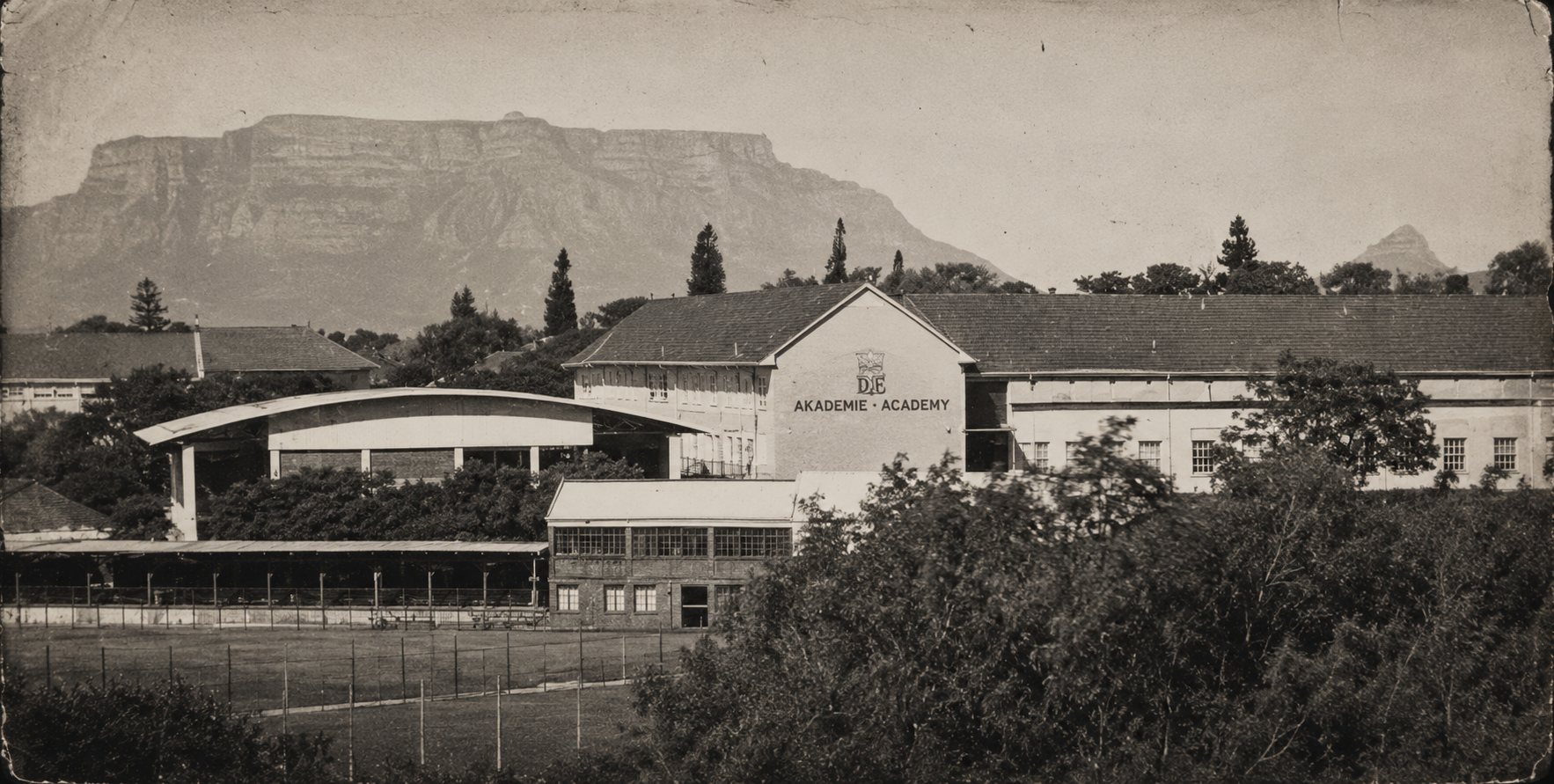
But until then, there remains a striking historical irony above the entrance to the Bellville institution:
The school says goodbye to DF Malan — while keeping DF.
That is not necessarily hypocrisy in the legal sense.
But as a matter of historical symbolism, it is difficult to avoid the conclusion that the institution has not completely escaped the name it decided was no longer acceptable.
It has simply shortened it.