
Governor Grey extends the Queen’s dominion over a chain of Atlantic islands
CAPE TOWN — 12 AUGUST 1861
A significant proclamation has been issued today from Cape Town which extends the authority of Queen Victoria over a group of islands and rocks lying off the south-west coast of Africa.
Sir George Grey, Governor of the Cape of Good Hope, has proclaimed that the sovereignty and dominion of Her Majesty the Queen shall extend to Penguin Island and ten neighbouring islands and rocks.
The proclamation names Hollamsbird, Mercury, Long Island, Seal Island, Penguin Island, Halifax, Possession, Albatross Rock, Pomona, Plumpudding and Roast Beef, or Sinclair’s Island.
The proclamation is issued under the public seal of the Colony and takes effect forthwith — although Governor Grey has expressly made it subject to confirmation or disallowance by Her Majesty the Queen.
The document is issued by command of the Governor by Richard Southey, Acting Colonial Secretary.
A valuable stretch of ocean
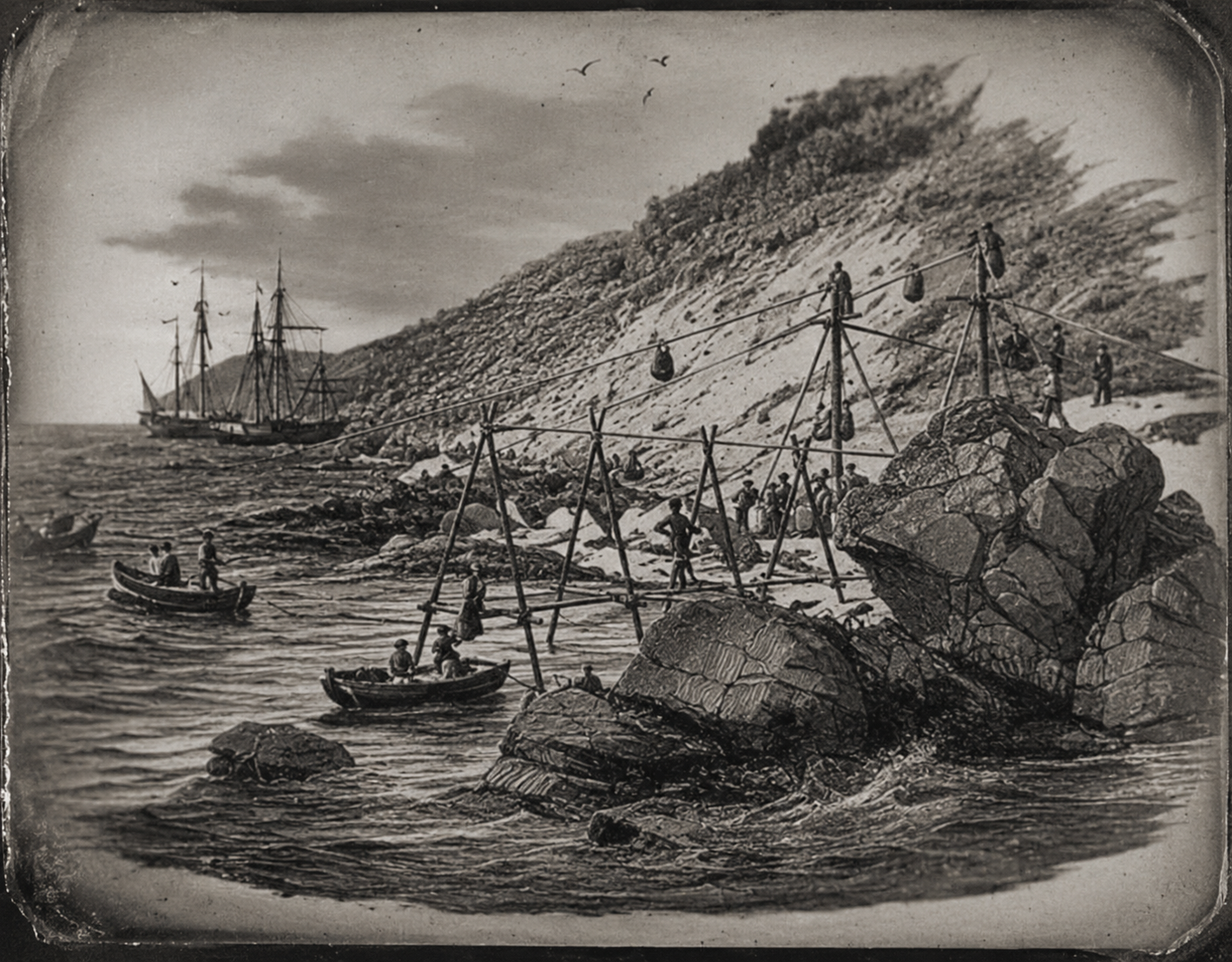
These islands may be small and desolate, but they have assumed considerable importance because of the extraordinary value of guano, which is being gathered in great quantities for use as agricultural fertiliser.
The guano trade has brought merchants from Cape Town and elsewhere into direct competition for control of the islands.
The commercial interests involved are considerable.
Among those with interests in the trade is the Cape firm of De Pass, Spence and Company, associated with Daniel de Pass and John Spence, which has already been involved in the exploitation of guano at Ichaboe.
It is understood that merchants interested in the trade have brought the question of the neighbouring islands directly before Governor Grey.
Ichaboe already under the British flag
Today’s proclamation follows Britain’s occupation of Ichaboe Island on 21 June this year.
The island was then taken possession of in the name of Queen Victoria and declared a dependency of the Cape of Good Hope.
The move has now been followed by Governor Grey’s much broader declaration.
The Governor’s proclamation states that the “sovereignty and dominion” of Queen Victoria shall extend over the islands and rocks named.
But there is an important reservation.
The Governor makes the proclamation expressly subject to Her Majesty’s confirmation or disallowance.
The Cape has therefore acted, but the final decision remains with the Crown.
Merchants welcome protection
Those engaged in commerce have obvious reasons to favour the extension of British authority.
The islands are becoming valuable commercial stations, not only because of their guano but also because of their importance to shipping.
Cape merchants subsequently involved in the matter will include William Anderson, Saxon & Co., whose interests are being represented by Sinclair, Hamilton & Co.
There is also property already associated with the islands.
Among the goods stored there is coal belonging to Cape Town merchants. James Murison, a Cape Town merchant, later gives evidence that Anderson, Saxon & Co. have approximately 250 tons of coal stored on Penguin Island.
For merchants whose property and commercial operations depend upon these remote islands, the presence of the British flag offers an obvious form of protection.
London may yet object
Yet today’s proclamation is unlikely to end the matter.
There are already grounds upon which the decision may be questioned.
The islands named by Governor Grey are not all immediately adjacent to Ichaboe. Some lie considerable distances away, raising questions about the extent of the Governor’s authority to bring them within the dominion of the Cape.
The British Government in London has not yet given its final approval.
Indeed, the very wording of today’s proclamation acknowledges that the Crown may confirm or disallow it.
The question is therefore now before Britain as much as it is before the Cape.
Where does the authority lie?
The issue may appear to concern little more than barren rocks in the Atlantic.
It does not.
The guano deposits are commercially valuable. The islands lie along an increasingly important maritime route. Cape merchants have invested money and property there, while the British Government must determine whether the Governor of the Cape has acted within his authority.
Those supporting the proclamation will argue that British sovereignty is necessary to protect commerce and maintain order.
Those questioning it will ask whether a colonial Governor can extend the Queen’s dominion over territories without prior approval from London.
At present, no reliable contemporary statement has been located from a named Cape politician or merchant publicly opposing today’s proclamation. It would therefore be improper to attribute opposition to an individual without evidence.
What is clear is that the legal and constitutional question remains open.
A new British frontier
For the moment, however, the position is unmistakable.
The Cape has laid claim to the Penguin Islands.
The British flag is being asserted over a chain of remote Atlantic islands whose value has grown enormously with the expansion of the guano trade.
Governor Grey has acted.
The Cape authorities have proclaimed the Queen’s sovereignty.
The merchants have much to gain.
And London now has the power to decide whether the Governor’s action will stand.
The proclamation has been made today. The controversy may only just be beginning.
CAPE CHRONICLE — HISTORICAL NOTE
Today’s proclamation should not be mistaken for the final settlement of the matter.
The question of the islands’ legal status will remain disputed. The British Government will subsequently examine Governor Grey’s action, and the islands will later be the subject of further British and Cape proclamations.
For now, however, 12 August 1861 marks the day on which Governor Sir George Grey formally attempts to place the Penguin Islands and their neighbouring rocks under the dominion of Queen Victoria through the authority of the Cape Colony.