
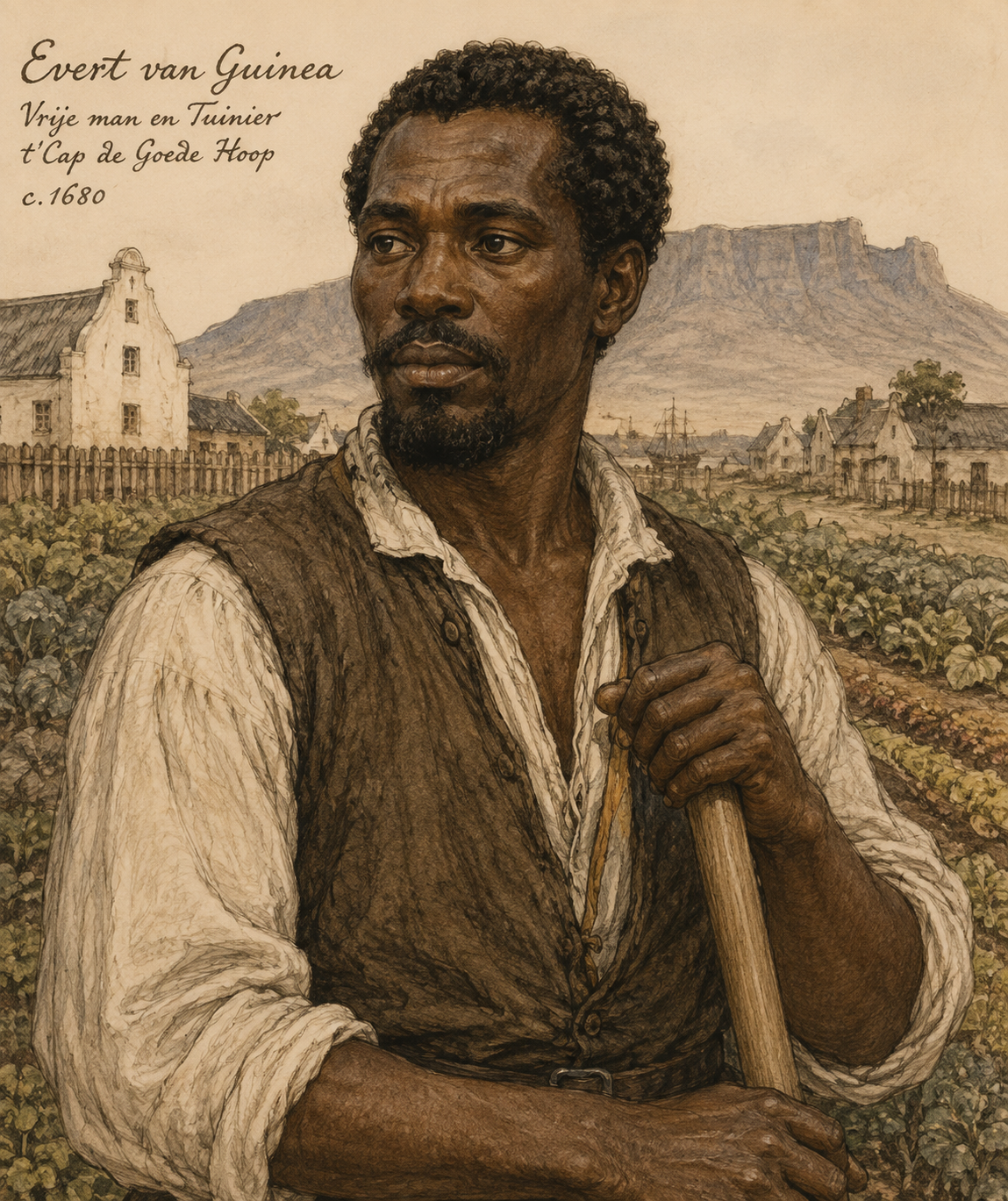
Long before the Cape’s vineyards became synonymous with wealth, prestige and international trade, its agricultural economy was being shaped by people whose names were seldom given prominence in the histories of the colony. Among them was Evert van Guinea, an African man who arrived at the Cape as an enslaved person and went on to become one of the earliest recorded free Black landholders and agriculturalists in the Dutch colony.
His story is inseparable from that of Anna van Guinea, with whom he established a household and agricultural livelihood, and from the remarkable career of their daughter, Zwarte Maria Evert, whose later landholdings would extend their family’s influence deep into the Cape’s agricultural economy.
From slavery to freedom
Evert arrived at the Cape in 1658 aboard the Hasselt, one of a group of Africans brought to the settlement after the vessel intercepted a Portuguese slave ship. The people aboard had been taken from West Africa, and they became part of the small but growing enslaved population of the Dutch settlement.
Within a remarkably short period, Evert’s circumstances changed.
He was manumitted by Jan van Riebeeck in 1659. The circumstances surrounding his release are part of the more complicated history of slavery at the Cape: Evert assisted the colonial authorities in locating people who had escaped from slavery. Freedom therefore came within a system that continued to depend upon forced labour.
For Evert, however, emancipation opened the possibility of establishing an independent livelihood.
A market garden in Table Valley
In July 1669, Evert received a garden in Table Valley from Commander Jacob Borghorst. The property measured approximately 723 square roeden, or just over one hectare.
This was not simply a residential plot.
Evert developed the land as a market garden, producing fruit and vegetables for the growing settlement. At a time when the Cape was still heavily dependent upon the Dutch East India Company and food production was one of the colony’s most pressing concerns, such gardens were an important part of the emerging local economy.
Evert subsequently expanded his holding. In November 1678, he purchased an adjoining garden from Hendrik Evertsz Schmidt for 250 guilders.
The transaction provides an important glimpse into the economic position Evert had achieved less than two decades after his emancipation. He was no longer simply producing enough food for his household. He was acquiring agricultural property and participating in the colony’s developing land market.
Anna van Guinea
The historical record gives considerably less detail about Anna than it does about Evert, largely because colonial documents tended to record property and commercial transactions in men’s names.
That absence should not be mistaken for an absence of contribution.
Anna and Evert appear together in the Cape’s early census and household records, and she was part of the farming household during the period in which Evert developed his agricultural interests. Following Evert’s death around 1688, Anna remained economically active.
One particularly revealing record lists Anna at Stellenbosch with their daughter and twelve cattle.
For an early Cape household, livestock represented more than food. Cattle were agricultural capital, a source of milk and meat, and a means of building wealth. Anna’s continued possession of livestock suggests that the family’s agricultural enterprise did not simply disappear with Evert’s death.
Her precise day-to-day responsibilities remain difficult to establish from the surviving documentation, but Anna deserves recognition as part of this early farming household rather than being reduced to a name beside her husband’s.
The move to Stellenbosch
Evert’s agricultural ambitions eventually extended beyond Table Valley.
By 1682 he was associated with Welgelegen in the Stellenbosch district, making him one of the earliest documented free Black farmers in the area.
Stellenbosch was becoming an important agricultural centre, with farms supplying grain, livestock, fruit, wine and other produce to the colony. Evert’s presence there demonstrates that free people of African origin were participating in this expansion at a very early stage.
He did not remain at Welgelegen indefinitely. Later records indicate that he sold the property in 1685. Decades later, in 1715, another applicant for the land referred to Evert’s earlier occupation of it, providing valuable confirmation of his presence there.
His agricultural career therefore encompassed both market gardening in Table Valley and farming in the Stellenbosch district.
A legacy carried by Zwarte Maria
Perhaps the most important part of Evert and Anna’s story lies with their daughter.
Zwarte Maria Evert, born around 1663, grew up within the agricultural world created by her parents. Historical accounts indicate that she learned about farming and the selling of produce through her father’s market garden.
She would eventually become a substantial landowner and farmer in her own right.
Maria’s agricultural interests included grain, fruit, vines and livestock, and her property holdings extended beyond the immediate Cape Town area. Her success demonstrates that the knowledge acquired in Evert and Anna’s household did not end with their generation.
It was transmitted to their daughter, who transformed it into a much larger agricultural enterprise.
From a Table Valley garden to Constantia
The family’s agricultural legacy would eventually become intertwined with one of the most famous names in Cape wine.
Maria’s son, Johannes Colijn, became associated with Constantia and played an important role in establishing the wine’s commercial reputation beyond the Cape.
The international fame of Constantia is traditionally associated with European landowners and colonial wine merchants, but the story is more complicated. Behind Colijn’s contribution was his mother Maria, and behind Maria’s agricultural education stood Evert and Anna.
The chain of inheritance was not simply one of land.
It was also one of agricultural knowledge, commercial experience and familiarity with the Cape’s developing food and wine economy.
A different history of the Cape farm
Evert van Guinea’s life challenges the familiar image of early Cape agriculture as an enterprise created exclusively by European settlers.
The colony’s farms, gardens and vineyards existed within a society built on slavery, and enslaved Africans were essential to agricultural production. Yet the records also reveal another story: some formerly enslaved people were able to acquire freedom, obtain land and establish independent agricultural enterprises.
Evert was among the earliest examples.
His life began in a slave ship and continued in a colonial society that placed enormous restrictions upon people of African origin. Nevertheless, within the opportunities and limitations of that society, he acquired land, cultivated produce, expanded his property and entered the farming economy of Stellenbosch.
Anna continued the household’s agricultural connection after his death, while their daughter built upon the foundation her parents had created.
For the history of Cape agriculture, that makes Evert more than a footnote in the history of slavery.
He was a farmer. He was a landholder. And he was part of the generation that helped establish agriculture beyond the boundaries of the European settler community.
The story of the Cape farm therefore begins in more places than the grand estates whose names survived into the modern era. In a small garden in Table Valley, in a household headed by two formerly enslaved Africans, one can find an early chapter in the story of independent Black agriculture at the Cape.
And from that garden came a family whose agricultural influence would eventually reach into the vineyards of Constantia and the international story of Cape wine.
Evert van Guinea’s name may have faded from the landscape, but the agricultural legacy of his family did not.