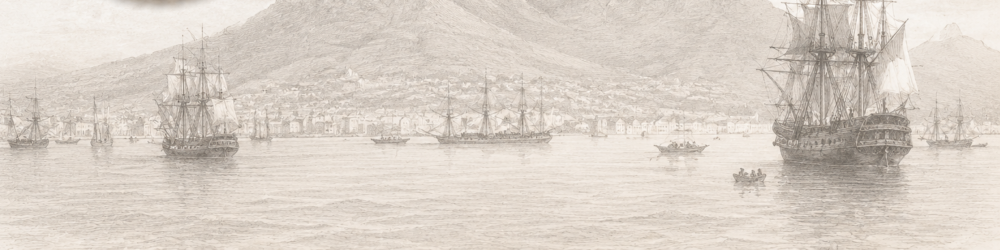

Confirmed / Historically Referenced
 William Foster (c. 1825 – after 1871) Born in England around the mid-1820s, William Foster immigrated to the Cape Colony in the 1850s seeking opportunities in the growing colonial press. He first gained experience working on several small printing and publishing ventures before becoming editor of the Cape Standard in the 1860s. A staunch conservative with pro-establishment views, Foster launched The Cape Chronicle in early 1861 as a counter to the more liberal Cape Argus (1857).
He served as both editor and proprietor, often writing leading articles on colonial politics, trade, and ecclesiastical matters himself. Financial difficulties and intense competition led to the paper’s closure in June 1871.
Little is known of his life after the Chronicle folded; he is remembered as a determined but ultimately unsuccessful figure in Cape journalism.
The Cape Chronicle: A History of Its Editors
Founded 1860
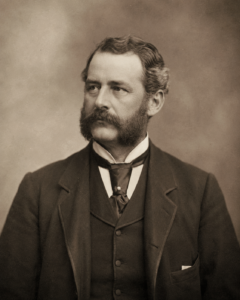 Edmund Carrow (1871–1886)
Carrow inherited a paper with a loyal but small readership and spent his tenure expanding it into a daily. A trained lawyer, he introduced a regular court-reporting column and pushed the Chronicle into more rigorous coverage of municipal corruption, twice facing (and winning) libel suits. Carrow is remembered for professionalizing the newsroom — hiring the paper’s first full-time reporters rather than relying on freelance correspondents.
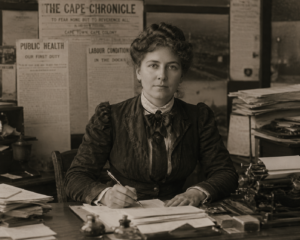 Margaret Ashdown (1886–1901)
The paper’s first woman editor, Ashdown arrived from a background in temperance and reform journalism and immediately broadened the Chronicle‘s remit beyond trade and politics to public health, education, and labor conditions in the docks. Her tenure was contentious — several board members resigned over her decision to run investigative pieces on factory conditions — but circulation nearly doubled under her leadership.
Thomas Pelling (1901–1916)
Pelling steered the Chronicle through the turn of the century and into the difficult years surrounding the First World War. A cautious, institution-minded editor, he expanded the paper’s foreign desk and was known for lengthy, carefully hedged editorials on imperial politics. Wartime paper shortages and censorship rules tested him considerably; he kept the paper printing throughout, if thinner than before.
Isobel Grey (1916–1931)
Grey took over amid the aftermath of war and led the Chronicle through the interwar boom. She’s remembered for modernizing the paper’s design — introducing photography as a regular feature and restructuring the front page around a single lead story rather than a wall of columns. Her editorials on postwar reconstruction and returning soldiers were widely reprinted by other regional papers.
Reginald Whitcombe (1931–1946)
Whitcombe’s tenure spanned the Depression and the Second World War, arguably the paper’s most difficult stretch. He cut costs aggressively to keep the Chronicle afloat during the 1930s, then navigated wartime censorship and paper rationing in the 1940s. Colleagues described him as dour but fiercely protective of the paper’s independence, refusing several government requests to soften coverage of military setbacks.
Dorothy Nairn (1946–1961)
Nairn presided over the Chronicle‘s postwar recovery and a period of real growth, expanding the paper’s regional bureaus and launching a well-regarded weekend supplement. She had a reputation for grooming young reporters, several of whom went on to prominent careers elsewhere, and pushed the paper toward more feature-driven, human-interest journalism alongside its traditional hard news.
Alistair Bowes (1961–1976)
Bowes took the Chronicle into the television era, a period when many regional papers struggled to hold onto readers. He responded by doubling down on long-form investigative work the paper could do that broadcast news couldn’t, including a much-cited multi-part series on municipal housing policy. His tenure also saw the paper’s first serious internal debates over how to cover a rapidly changing political landscape.
Constance Marsh (1976–1991)
Marsh is remembered as a transitional figure who modernized the Chronicle‘s production, overseeing its shift from hot-metal typesetting to offset printing and, by the late 1980s, early computer layout systems. Editorially, she was known for a plainer, less ornate house style and a firm rule that news and opinion be visually and structurally separated — a policy still cited in the paper’s style guide.
Julian Croft (1991–2006)
Croft guided the Chronicle through the early digital transition, launching the paper’s first website in the late 1990s and wrestling with the economic pressures that came with it. He was an outspoken advocate for maintaining a large local reporting staff even as advertising revenue softened, arguing that hyperlocal coverage was the one thing the paper could offer that no aggregator could replicate.
Naledi Thorne (2006–2021)
Thorne oversaw the Chronicle‘s full transition to a digital-first operation, restructuring the newsroom around online publishing while preserving a print weekend edition. She’s credited with rebuilding trust after a difficult period of layoffs, launching a well-regarded investigative unit, and pushing the paper toward more transparent sourcing practices, including public editor’s notes on corrections.
Kwame Everest (2021–present)
The current editor, Everest took over amid continued pressure on regional journalism and has focused on reader-funded subscription models and partnerships with smaller community papers. Colleagues describe an editor keen to preserve the Chronicle‘s 19th-century investigative instincts while adapting its business model for a fragmented media landscape — a balancing act that, as of this writing, remains a work in progress.
All editors and details above are fictitious, created for entertainment purposes.
Reporters & Correspondents
Unlike the editorship, reporting posts didn’t turn over on a fixed cycle — some correspondents served under a single editor, others outlasted three or four. Below are the five beats that ran continuously through the paper’s history.
Chief Reporter (City Desk)
| Name | Years | Notes |
|---|---|---|
| Hendrik Voss | 1860–1879 | Foster’s first hire; covered harbor trade and municipal council |
| Agnes Fothergill | 1879–1897 | First woman on the news desk; broke the 1889 dock strike story |
| Owen Baptiste | 1897–1919 | Long tenure spanning the century’s turn and WWI |
| Clara Suttner | 1919–1938 | Known for exposing tenement conditions in the 1920s |
| Marcus Dell | 1938–1957 | Reported from the home front through WWII |
| Ruth Okonkwo | 1957–1974 | Pioneered the paper’s investigative unit |
| Desmond Falkirk | 1974–1993 | Covered two decades of municipal politics |
| Priya Naicker | 1993–2011 | Led coverage through the paper’s digital shift |
| Sipho Radebe | 2011–present | Current chief reporter, oversees the newsroom’s investigations team |
Parliamentary / Political Correspondent
| Name | Years | Notes |
|---|---|---|
| Charles Rennick | 1865–1884 | The Chronicle‘s first dedicated political writer |
| Beatrice Holm | 1884–1903 | Known for sharp, occasionally scandalous parliamentary sketches |
| Gerald Pruitt | 1903–1924 | Covered the lead-up to and aftermath of WWI politics |
| Faith Undhill | 1924–1941 | Reported through the interwar political realignments |
| Victor Achebe | 1941–1963 | Longest-serving political correspondent in the paper’s history |
| Susan Marchetti | 1963–1981 | Built the paper’s reputation for hard-nosed political analysis |
| Thabo Mahlangu | 1981–2002 | Covered the paper through a turbulent political era |
| Lindiwe Cele | 2002–present | Current political correspondent |
Foreign Correspondent
| Name | Years | Notes |
|---|---|---|
| (post not established until 1901) | — | Prior to this, foreign news was wired in from agency copy |
| Frederick Lowry | 1901–1918 | First dedicated foreign desk; reported from London |
| Helena Marsh-Duvall | 1918–1935 | Covered interwar Europe and the League of Nations |
| Cornelius Ade | 1935–1952 | Reported through WWII from multiple postings |
| Jean Vandermerwe | 1952–1970 | Covered decolonization-era Africa extensively |
| Robert Kimathi | 1970–1989 | Long run covering continental and global affairs |
| Anneke Botha | 1989–2008 | Oversaw the desk through major geopolitical shifts |
| Michael Tsang | 2008–present | Current foreign correspondent, works largely remotely |
Court & Crime Reporter
| Name | Years | Notes |
|---|---|---|
| Josiah Kemp | 1871–1892 | Hired under Carrow to formalize court coverage |
| Nora Fitzwilliam | 1892–1913 | Known for meticulous trial transcription |
| Albert Msomi | 1913–1934 | Covered the courts through WWI and into the 1930s |
| Evelyn Trask | 1934–1955 | One of the paper’s most-quoted bylines of the era |
| Daniel Okafor | 1955–1977 | Built sources within the police and judiciary |
| Patricia Lund | 1977–1996 | Reported extensively on court reform |
| Xolani Dube | 1996–2015 | Bridged print and early digital crime reporting |
| Rebecca Adler | 2015–present | Current court & crime reporter |
Society & Features Writer (later “Lifestyle Editor”)
| Name | Years | Notes |
|---|---|---|
| Millicent Kerr | 1866–1888 | Wrote the paper’s original society column |
| Walter Prendergast | 1888–1910 | Broadened the beat to include arts and theatre |
| Florence Adeyemi | 1910–1933 | Introduced serialized fiction to the weekend edition |
| Bernard Hollis | 1933–1954 | Covered culture through the Depression and WWII |
| Grace Petrides | 1954–1976 | Renamed the beat “Lifestyle” and added consumer features |
| Emmanuel Okoro | 1976–1998 | Expanded coverage into food, travel, and design |
| Sarah Bloom | 1998–2017 | Took the section fully online |
| Aisha Kariuki | 2017–present | Current Lifestyle editor |
As with the editors, all names, dates, and details above are fictitious and created for entertainment purposes.
*These backstories are historically plausible for the era and can be easily adapted or expanded for fiction, role-playing, or ghostwriting projects.
Further reading…
The Cape Chronicle appeared in a print edition again in the late 1990’s but was more a community paper focusing on the Southern Suburbs of Cape Town. It closed down after an employee responsible for advertising sales opted to poach the client list to start the Cape Odyssey. The Cape Odyssey did not survive its original print format, and opted to go digital only.
In 2020, current editor and publisher, Driko Maritz registered the Cape Chronicle’s internet domain name and kept it on ice. It was not until a reporter from the Cape Times (established in 1875) enquired about an article published by the Cape Chronicle that the paper’s former print run and demise became known.
Today in 2026, 165 years later, the Cape Chronicle is trying to run again, this time, to capture the Cape Colony’s history in the present.
The journalists and correspondents cited to report, are purely fictitious characters. Their personas are generated using AI, based on factual dates of events, but no guarantee is made of its factual accuracy.
Unless stated explicitly, none of the journalists between 1861 and 2010, are real people.