
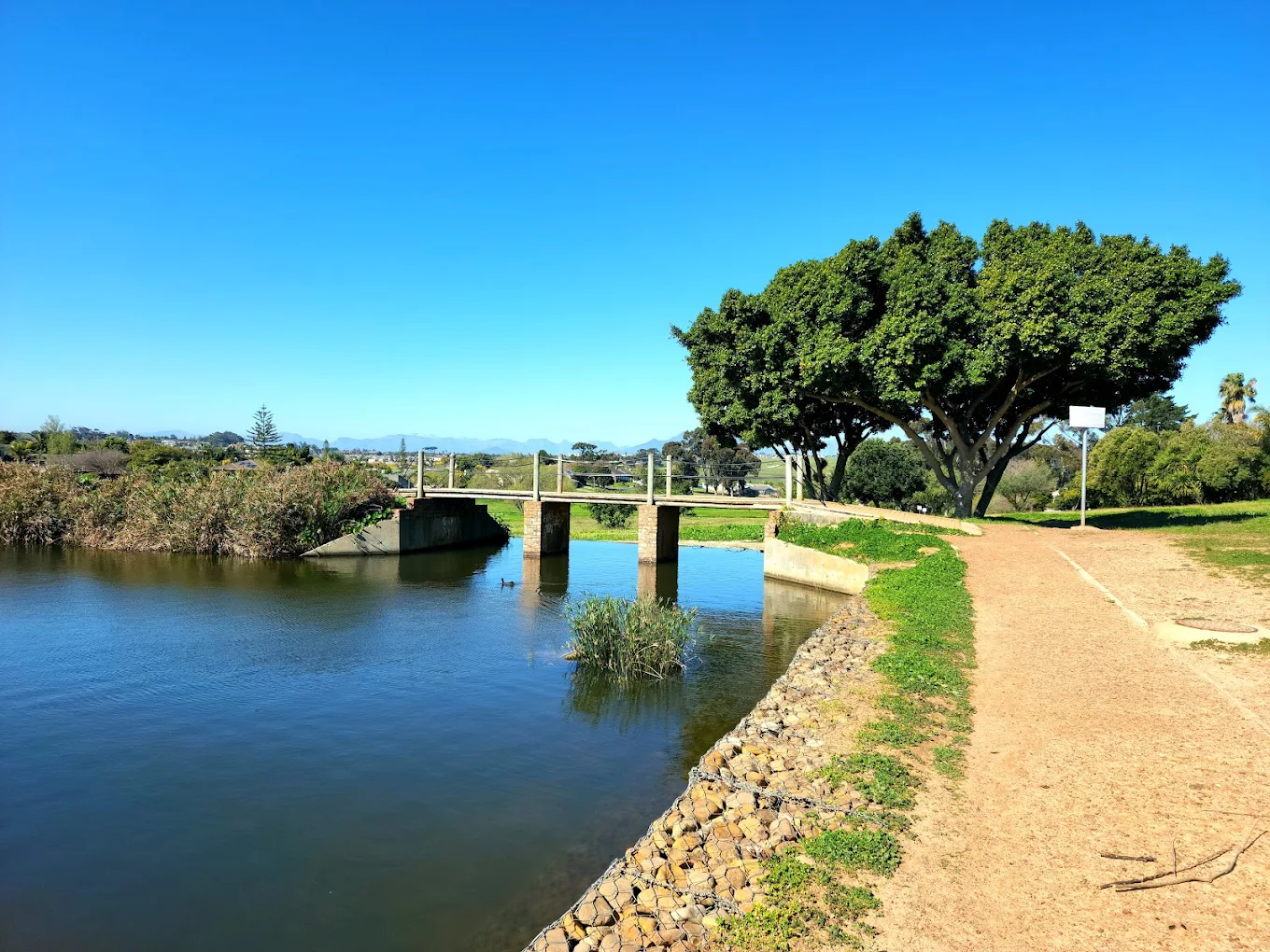
Tucked into the suburb of Vygeboom in Durbanville, Sonstraal Dam is one of those quiet Cape Town landmarks that most Northern Suburbs residents have a childhood memory of — feeding ducks, wandering the footbridge at sunset, or watching a fleet of miniature sailboats glide across the water. Yet behind its postcard calm lies a working piece of civic infrastructure with a history that says a lot about how Cape Town’s utilitarian spaces so often grow into beloved public places.
 A Dam Built for Function, Not Leisure
Sonstraal Dam was never designed as a tourist attraction. It is, at its core, a stormwater catchment facility — the lower of two such dams built within what the City of Cape Town now designates as Ward 21. Its name, drawn from Afrikaans, translates roughly to “sun’s rays,” a fitting description for the golden light that spills across the water in the late afternoon, a scene that has drawn photographers and dog-walkers for decades.
For most of its existence, the dam’s primary job was managing runoff for the surrounding residential area, with recreation happening almost as an afterthought — a byproduct of having an open body of water in the middle of a growing suburb.
Decline, Disease, and a Difficult Chapter
Like many urban water bodies, Sonstraal Dam went through a rough patch. Long-time visitors recall a period when litter accumulated faster than it could be cleared and the surrounds fell into visible neglect. The situation worsened in 2005, when an outbreak of avian botulism struck the local bird population. Although the outbreak was eventually contained, the City opted to keep a permanent ban on fishing at the dam afterward, in order to protect the waterfowl that use it as a breeding site. Swimming and boating for the public have also long been off-limits, preserving the dam primarily as a habitat and walking destination rather than a swimming spot.
A Slow Transformation into a Recreational Hub
Despite those restrictions, the dam’s appeal never really faded — if anything, its role shifted. Over time, Sonstraal Dam became something closer to a neighbourhood park built around water: a looped walking path, benches in the shade, open lawns for picnics, and a footbridge that has become something of an unofficial local landmark.
One niche pursuit has given the dam a distinctive identity within the Tygerberg area: it is the only public dam in the City of Cape Town officially designated for radio-controlled boating. It serves as the yachting pond for the Northern City Radio Sailing club and is used by DF95 class racers as an alternative venue, giving weekend visitors the occasional spectacle of a small armada of remote-controlled yachts tacking across the water.
The City has also treated the dam as infrastructure worth protecting for the long term. In 2024, it undertook a substantial renovation programme, including reinforcing the embankment crest, installing rock riprap on the upstream slope, adding water-level gauges, repairing cracked concrete in the spillway and training walls, and building a new spillway outfall channel with gabions to guard against erosion — all signs that the City now regards the dam as both flood infrastructure and a public amenity worth maintaining.
Today, Sonstraal Dam sits alongside other green spaces that define the character of the Tygerberg area — the Tygerberg Nature Reserve, the Durbanville Rose Garden, and the Durbanville Nature Reserve — forming part of an informal network of pockets of nature that locals lean on for a break from suburban life.
 What Visitors Say
The dam’s Google reviews paint a picture of a place people feel genuinely attached to, warts and all. Many describe it as a peaceful, almost meditative escape — one visitor likened the atmosphere to strolling through a green oasis full of picnicking families, while another called it a private, stress-relieving retreat they would happily live beside.
Families in particular seem to treat it as a rite of passage: reviewers mention children cycling or walking with parents, dogs being taken for leashed walks, and grandchildren delighting in feeding the ducks. Several long-time residents describe it fondly as an unchanged piece of their childhood neighbourhood, a place still worth a detour decades later.
Not every comment is glowing, however. A recurring complaint concerns litter and bins that visitors feel aren’t emptied often enough, with some suggesting people should carry their own rubbish out if they want the space to stay pleasant. A few reviewers have raised more serious concerns, including sightings of dead birds and fish along the shoreline, and occasional worries about smoking or other behaviour that feels out of step with a nature spot. Others simply wish the grassed areas around the water were better maintained for the resident geese.
Taken together, the reviews suggest a space that’s deeply loved but still dependent on upkeep and community respect to stay that way — a dynamic that mirrors its history: a dam originally built for flood control that only thrives as a recreational hub when both the City and the public treat it as worth caring for.