

Cape Town’s reckless experiment with e-scooters and e-bikes must end before a pedestrian is killed
By the Cape Chronicle Investigative Desk
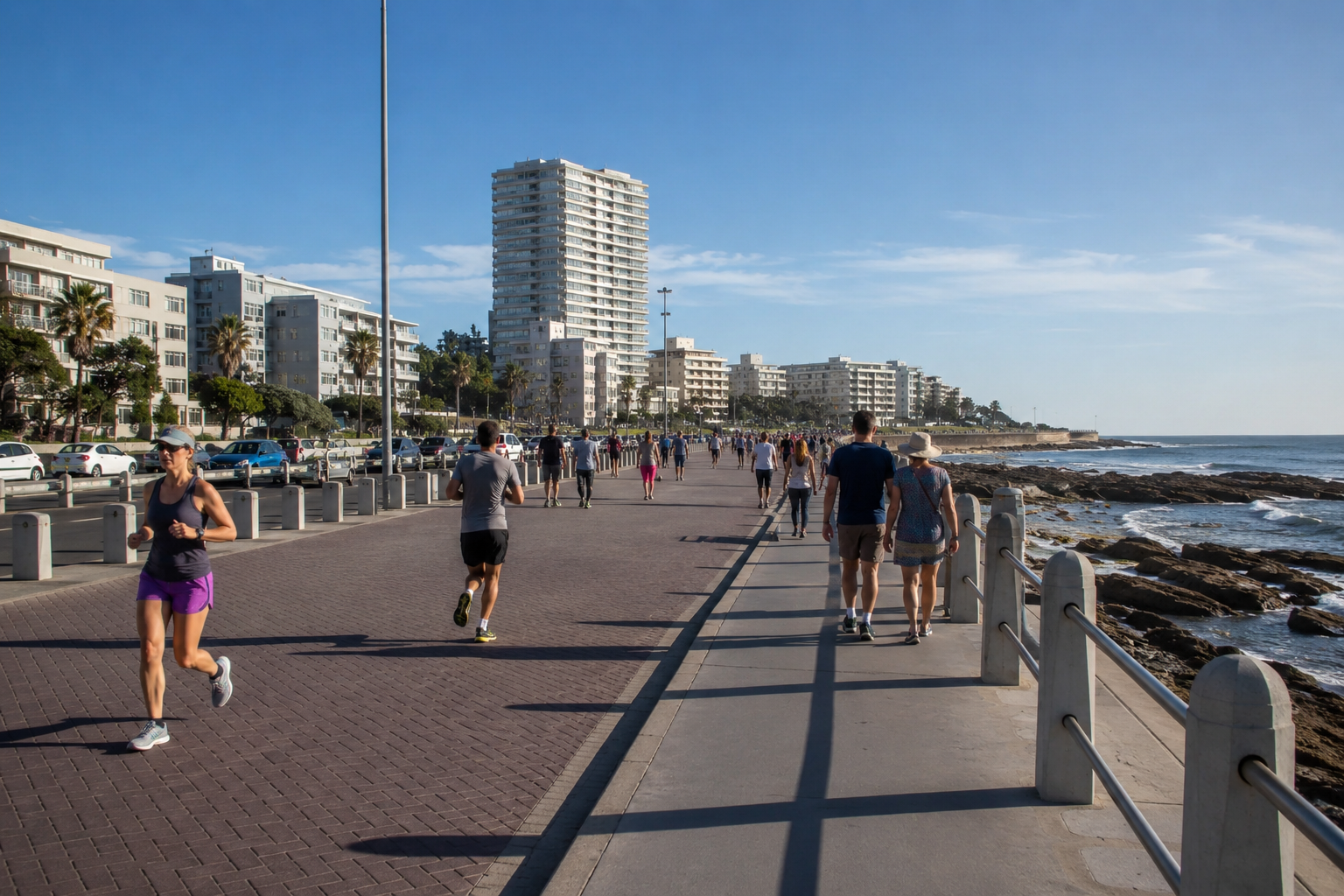
There is something profoundly wrong with the idea of a pedestrian promenade becoming a racetrack for electric scooters and bicycles.
The Sea Point Promenade was created for people.
People walking beside the ocean.
Children chasing one another.
Grandparents taking an afternoon stroll.
Runners getting their exercise.
People pushing prams.
Visitors taking photographs.
People simply sitting down and watching the Atlantic.
It was never designed as an electric transport corridor.
Yet today, pedestrians are expected to share this heavily used recreational space with increasingly powerful electric devices capable of travelling considerably faster than a walking human can react.
And the City of Cape Town’s answer?
Slow them down.
The latest Sea Point Promenade Management Protocol introduces an 8 km/h speed limit in shared pedestrian areas, gives pedestrians right of way and promises stronger controls on reckless riding. (IOL)
That sounds reassuring.
It isn’t!
Because the question the City should be asking is not:
“How slowly can we allow motorised devices to travel amongst pedestrians?”
It should be:
“Why are motorised devices there at all?”
Cape Town has already been warned
The most damning evidence against the City’s present approach comes from the City itself.
In 2022, after a five-month investigation, Cape Town proposed making the Sea Point Promenade between Mouille Point and the Pavilion exclusively pedestrian.
The City’s investigation found that approximately 90% of promenade users were pedestrians or joggers.
The City specifically warned that children and elderly people were vulnerable to serious injury from electric bicycles, e-scooters and other devices travelling at speed.
It proposed that no e-bikes, e-scooters or motorised devices be allowed on the promenade. (Cape Town Municipality)
So what happened?
The City didn’t follow through.
The pedestrian was effectively asked to negotiate with the machine.
Now, four years later, the problem has become sufficiently serious for the City to introduce an 8 km/h rule.
That is not a triumph of regulation.
It is an admission that the experiment has gone wrong.
A seven-year-old has already paid the price
On 1 April 2026, a seven-year-old girl was walking along the Promenade with her family when, according to her father, she was struck by a speeding electric scooter.
She was knocked to the ground and suffered bruising, facial cuts and swelling to her knee. Her ten-year-old sister was almost hit by another scooter moments later. The injured child was taken for medical assessment. (IOL)
This is precisely the sort of incident the City warned about in 2022.
And it wasn’t some theoretical possibility.
It happened.
Residents have subsequently reported other near misses and collisions, including a case in which a resident reportedly required knee surgery after being struck by an electric scooter. (IOL)
The complaints have involved children, elderly people, runners and other pedestrians.
The City has known about the conflict for years.
These aren’t bicycles with a battery
There is an important distinction being lost in this debate.
A conventional bicycle requires physical effort.
An electric scooter does not.
An electric bicycle can multiply the rider’s ability to maintain speed.
And some modern electric devices are heavy, powerful machines capable of moving through a crowded pedestrian environment with very little warning.
The danger isn’t simply the top speed.
It is the combination of:
- acceleration;
- weight;
- silence;
- small physical footprint;
- inexperienced riders;
- children using devices;
- unpredictable pedestrian movement;
- crowded pathways; and
- the absence of meaningful physical separation.
A pedestrian looking backwards at a child, talking to a companion or simply changing direction cannot be expected to calculate the trajectory of a rapidly approaching silent electric vehicle.
That is not how pedestrian spaces work.
The international warning signs are everywhere
Cape Town is hardly the first city to discover that mixing motorised micro-mobility with pedestrians creates problems.
London: pedestrians have been seriously injured
British government statistics for 2023 recorded 186 pedestrian casualties in collisions involving e-scooters, including 52 serious injuries. (GOV.UK)
The figures are not merely about reckless riders injuring themselves.
Pedestrians are being injured too.
One particularly grim British case involved Linda Davis, who was killed after being struck by a 14-year-old riding a private e-scooter on a pavement. She has been described as the first pedestrian killed in an e-scooter collision in the UK. (The Guardian)
Another fatal case involved Mustafa Nadeem, who collided with a pedestrian while riding an e-scooter on a pavement in Birmingham before falling into the path of a bus. (Courts and Tribunals Judiciary)
London’s authorities have therefore had to grapple with a very basic question:
Where does an electric scooter belong?
Increasingly, the answer has been: not on the pedestrian pavement.
Paris: the injury evidence came early
Paris provides an even more useful warning.
A peer-reviewed study examining 125 patients treated for electric-scooter-related facial and dental trauma in Paris between 2017 and 2019 found that two patients were pedestrians struck by e-scooters.
The study also found high-speed riding in 51% of cases and sidewalk riding in 31%.
Overall, risky behaviour was identified in 87% of cases where the relevant information was available. (JAMA Network)
Paris subsequently became dramatically more restrictive.
The city ultimately removed its dockless rental e-scooter fleet after a public vote, while the wider French regulatory environment has also imposed increasingly strict rules on electric personal mobility devices.
As of August 2026, Paris has introduced mandatory helmets and high-visibility equipment on public roads for users of these devices, citing concern over increasing serious and fatal accidents. (Paris)
Paris learned the hard way.
Cape Town should not have to.
Singapore: the city that actually chose pedestrians
Perhaps the most instructive example is Singapore.
Singapore banned e-scooters from all footpaths from 5 November 2019.
They could instead be used on designated cycling paths and Park Connector Networks.
The government explicitly said the decision was necessary because pedestrians needed to feel safe again on public paths. (Ministry of Transport)
And there was measurable evidence behind the decision.
Singapore’s Ministry of Transport reported that following the footpath ban, the number of accidents involving e-scooters on public paths fell by about 30%. (Ministry of Transport)
Singapore didn’t conclude that pedestrians should simply become better at dodging scooters.
It separated them.
What an extraordinary concept.
New York is debating the same question
New York provides another fascinating comparison.
In 2026, legislation was introduced in the New York City Council that would prohibit electric scooters and electric-assist bicycles throughout parks under the jurisdiction of the Parks Department.
Another proposed law would require signs informing riders that bicycles, e-bikes and e-scooters are prohibited on park walkways and boardwalks, with priority given to locations experiencing high levels of death, injury or property damage and areas heavily used by seniors and people with disabilities. (New York City Council)
The legislation had not become law at the time of writing, so it would be misleading to describe New York as having already imposed a citywide park ban.
But the political debate tells us something important:
One of the world’s biggest cities is actively considering removing these devices from parks precisely because parks contain pedestrians.
Los Angeles already draws the line
Los Angeles provides an even clearer example.
Its municipal regulations prohibit motorised scooters on boardwalks, sidewalks, bike paths and other public ways in specified waterfront park areas. (American Legal Publishing)
Again, the principle is remarkably simple:
A pedestrian facility is not automatically a motorised-vehicle facility merely because the vehicle happens to be small and electric.
The international lesson is brutally simple
| City / jurisdiction | Approach |
|---|---|
| Singapore | E-scooters banned from footpaths; use restricted to cycling paths and designated networks. (OneMotoring) |
| Los Angeles | Motorised scooters prohibited on specified waterfront boardwalks, sidewalks and bike paths. (American Legal Publishing) |
| New York City | Proposals introduced to prohibit e-scooters and e-bikes in parks and on park walkways/boardwalks. (New York City Council) |
| Paris | Increasingly strict regulation following serious injury and fatality concerns. (Paris) |
| London / Great Britain | Private e-scooters remain illegal on public roads and pavements; rental schemes operate under controlled conditions. (London City Hall) |
| Cape Town | Shared use continues, with an 8 km/h limit and tighter controls introduced in 2026. (IOL) |
The global trend is not towards giving pedestrians more responsibility for avoiding electric vehicles.
It is towards separation, designated infrastructure and stronger restrictions.
And then there is the Sea Point Promenade
Here’s the absurdity.
Cape Town knows that the overwhelming majority of users are pedestrians and joggers.
Cape Town knows that children and elderly people are particularly vulnerable.
Cape Town investigated the problem.
Cape Town previously recommended excluding e-bikes and e-scooters.
Cape Town has received complaints.
Cape Town has now had actual collisions.
And the solution is an 8 km/h speed limit.
Eight kilometres per hour.
On a promenade where people are walking.
That is barely faster than a brisk human walking pace — yet the device still has wheels, mass, acceleration and a rider who may not be paying attention.
And who is expected to enforce this?
The same public-space management system that has struggled to prevent speeding in the first place?
Enough with the experiment
It is time to stop pretending this is a difficult philosophical question.
Nobody is proposing that Cape Town ban bicycles.
Nobody is proposing that people with disabilities lose access to mobility devices.
Nobody is proposing that electric mobility disappear.
The issue is location.
Put e-scooters and fast e-bikes where they belong:
on properly designed cycling infrastructure.
Build dedicated lanes.
Create safe routes.
Use geofencing.
Separate pedestrians from powered devices.
But stop using a pedestrian promenade as the experimental laboratory for electric mobility.
The precautionary principle should apply
The City does not need to wait for a fatality.
That is the most disturbing part of this entire debate.
A seven-year-old has already been injured.
A resident has reportedly required surgery.
Pedestrians have reported repeated near misses.
International cities have recorded serious pedestrian injuries and deaths.
Singapore saw accidents fall after removing e-scooters from footpaths.
And Cape Town’s own investigation warned that vulnerable pedestrians could suffer serious injury.
How many warning signs does the City require?
One death?
Two?
Ten?
Must a child be killed before somebody finally says:
“Perhaps electric scooters don’t belong here”?
That would be an obscene standard for public safety.
The Sea Point Promenade belongs to pedestrians
The promenade is one of Cape Town’s great public spaces.
It should be somewhere a pensioner can walk without looking over their shoulder.
Somewhere a parent can let a child walk beside them without calculating the speed of approaching vehicles.
Somewhere a blind person can move safely.
Somewhere a runner can run.
Somewhere a visitor can admire the ocean.
It should not be a place where pedestrians have to learn the rules of evasive manoeuvring because the City has decided that electric vehicles deserve a share of the pavement.
The phrase “pedestrian right of way” sounds wonderful.
But right of way is worthless if the pedestrian is lying injured on the pavement.
BAN THE MACHINES — NOT THE PEOPLE
Cape Town should immediately reconsider the presence of e-scooters and high-powered e-bikes on the Sea Point Promenade.
The City should:
1. Ban rental and privately operated e-scooters from the pedestrian promenade.
2. Ban high-powered e-bikes from the pedestrian promenade.
3. Retain access for wheelchairs, mobility aids and other legitimate disability-related devices.
4. Create clearly separated cycling and micromobility routes elsewhere.
5. Introduce proper physical separation rather than relying on painted lines and unenforceable etiquette.
6. Require rental operators to geofence prohibited areas.
7. Publish collision and injury statistics for the Promenade.
8. Publish the enforcement statistics — including how many riders have actually been stopped or fined.
And most importantly:
9. Stop waiting for somebody to die.
Electric scooters are not inherently evil.
Electric bicycles are not inherently evil.
They can be useful forms of transport.
But a useful machine in the wrong place becomes a hazard.
A chainsaw is a useful tool too.
You don’t hand one to somebody and tell the pedestrians to “give way.”
The Sea Point Promenade is a pedestrian recreational environment.
Let pedestrians have it back.
Because the real question isn’t whether an e-scooter can safely travel through a crowd at 8 km/h.
The question is why a pedestrian should have to share the space with it in the first place.
Cape Town should stop trying to make the promenade safer for electric vehicles.
It should make the promenade safe for pedestrians.
And that means one thing:
BAN THE PEDESTRIAN KILLING MACHINES FROM THE PROMENADE.
A small but important factual point: I deliberately didn’t claim that every city in the table has a blanket ban, because that would overstate the evidence. New York’s 2026 park ban is proposed legislation, for example, while Singapore’s footpath ban is actually in force. That distinction makes the argument considerably harder for the City to dismiss as sensationalism.