
A Cape Chronicle Heritage Feature
Long before it had a name that would fit on a signpost, the place we now call Durbanville was simply somewhere to stop.
In the mid-1600s, a Dutch East India Company surveyor mapping the colony’s water sources came upon a freshwater spring at the foot of the Tygerberg hills, growing wild beside a patch of pumpkins. He noted it down plainly, in the practical Dutch of the day, as Pampoenkraal — the pumpkin kraal. It was an unglamorous name for what would prove one of the most important stretches of ground on the road inland.
Why here?
The reason was written into the land itself. Ox-wagons hauling produce and passengers between Cape Town and the farms of the interior had two routes to choose from: the firm, clay-rich shoulders of the Tygerberg hills, or the treacherous, shifting sand of the Cape Flats to the south. Any wagon-driver with sense chose the hills. The track that wound over Tygerberg and down past the pumpkin patch offered solid footing and, just as importantly, a spring that rarely failed — sustaining travellers even through drought, by some accounts for nearly three centuries.
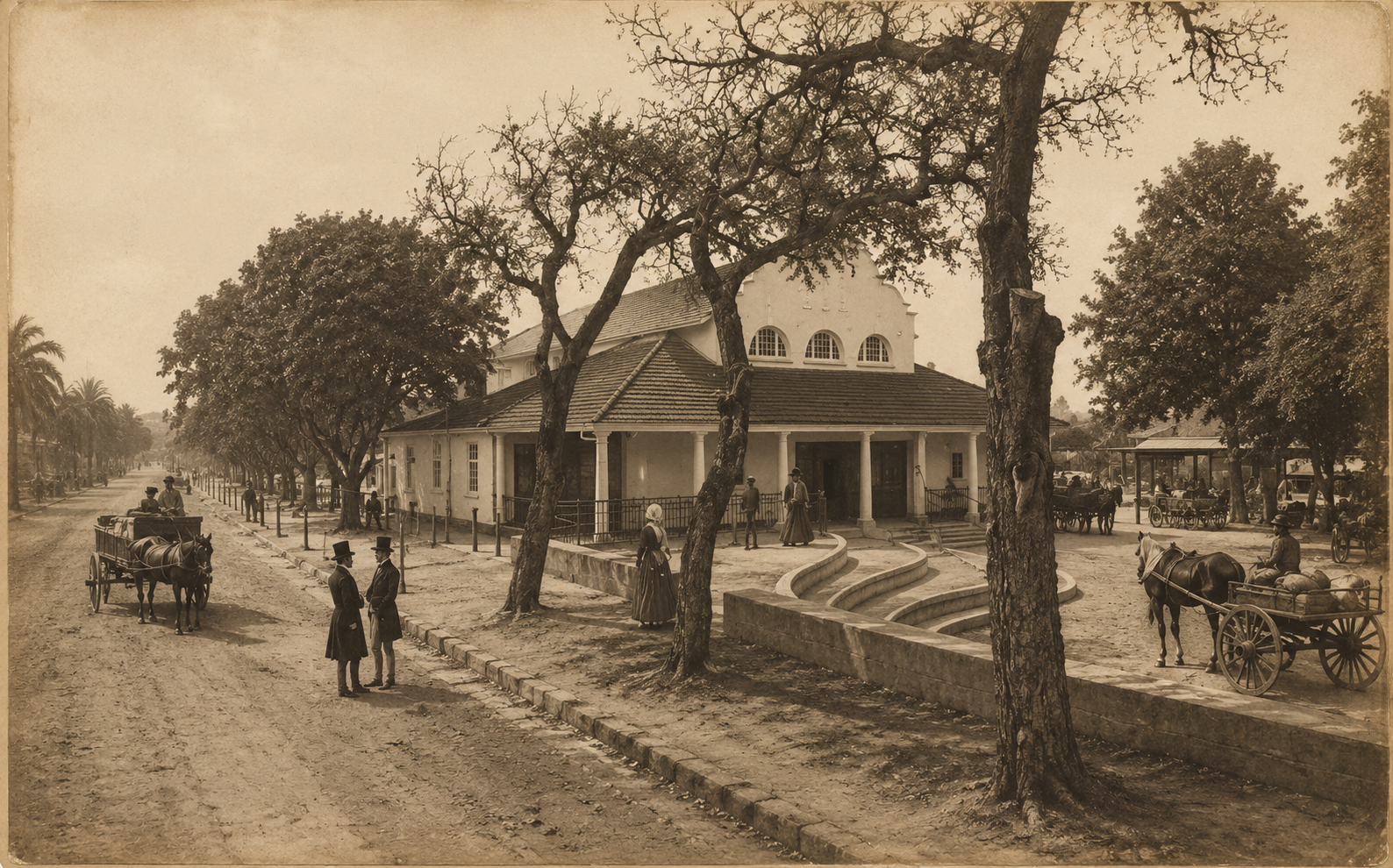
A resting point for wagons is called an outspan — the place where oxen are unyoked, fed and watered before the next stretch of road. Pampoenkraal became exactly that: the last outspan before Cape Town for wagons descending from the Roodezand and beyond, and the first stop for those heading out. Farmers gathered there to trade. Reverends passed through to visit scattered congregations. By the early 1800s, a scatter of huts, kraals and cart-sheds had grown up around the spring, and in 1806 the first residential plots were formally laid out — the quiet beginning of a town that didn’t yet know it was one.
A church, and a name
The next step toward permanence came in 1824, when a group of local farmers petitioned Governor Lord Charles Somerset for permission to build a church of their own, rather than making the long trek to worship elsewhere. Permission was granted, the foundation stone was laid the following year, and on 6 August 1826 the new Dutch Reformed Church was inaugurated — doing double duty, in the manner of frontier settlements, as the community’s first school as well. A small village began to take shape in the space between the church and the outspan.
Ten years later, the farmers of Pampoenkraal petitioned again — this time to rename their settlement. Sir Benjamin D’Urban, appointed Governor of the Cape Colony in 1834, had earned the respect of the farming community; petitioners praised him as industrious, orderly and fair. In 1836, permission was granted, and Pampoenkraal became D’Urban.
It did not stay D’Urban for long. Within a year, the far-off port on the eastern seaboard was named Durban in the same governor’s honour, and the confusion between the two proved too much to bear. In 1886, the Cape village adjusted its name one final time, adding four letters to become Durbanville — distinct, and its own.
From wagon stop to wagon works
Durbanville’s fortunes through the rest of the 19th century stayed tied to the road. As the wagon trade grew, so did the village’s importance as a supply centre — meat, wheat, fruit and vegetables moved through it to feed both inland settlements and the ships rounding the Cape. The King Brothers Wagon Works, established in the village, became known nationally for its carts and wagons, and by the 1870s Durbanville had grown substantial enough to warrant its own courthouse, jail and resident magistrate.
A village management board followed in 1897, and in 1901 Durbanville became a municipality in its own right, with John King elected its first mayor.
What remains
Much of that early village is still legible in the streets around Durbanville’s centre today. The old church still stands at Church and Oxford streets. Rust-en-Vrede, built in 1808 and later used as magistrate’s offices, now serves as a gallery. And the wine farms that ringed the original outspan — Meerendal, Bloemendal, Diemersdal and Altydgedacht among them — still work land their forebears first planted in the 1600s, their vines a living link back to the days when this was nothing more than a good place to unyoke the oxen and rest.
What began as a pumpkin patch beside a spring is now one of the fastest-growing suburbs on the Cape’s northern edge — proof that even the humblest resting place can, given time and water, grow into a town.