
1652–1795: Before there was a “telecom” industry
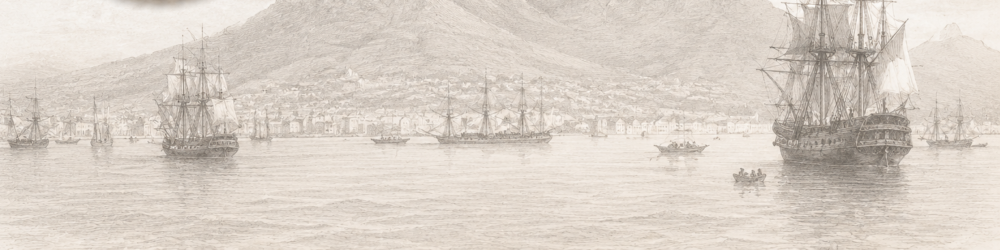
When Jan van Riebeeck arrived in 1652, communication at the Cape was entirely improvised. For decades before that, passing sailors had already been leaving messages under inscribed rocks near Table Bay — the so-called “postal stones” — where sailors etched ship names, captains’ names and arrival or departure dates into boulders and buried letter bundles nearby, hoping they’d be picked up by homeward-bound vessels. The earliest of these stones, dated 1619, was inscribed in English, showing this was already an established practice before the VOC’s formal settlement.
Once the Dutch established their replenishment station, this informal system persisted for over a century. The postal stones remained the only system on the peninsula until 1792, when acting governor Johan Isaac Rhenius opened a proper post office in a room at the Castle of Cape Town. Mail runners — often Khoikhoi servants carrying a cleft “briefstock” stick a metre or two long since they couldn’t carry letters on their bodies — handled local delivery.
1795–1860: British rule and the birth of formal telecoms
Control of the Cape shifted from Dutch to British hands (1795, then permanently from 1806), and the Cape became a strategic staging post on the sea route to India — an important focus of imperial communication linking Britain to its far-flung territories. A regulated postal service developed, and in 1853 the colony issued its now-famous triangular stamps — among the first in the world.
Electrical telecommunication arrived on 25 April 1860, when the Cape Town–Simon’s Town electric telegraph line opened, built for shipping and commerce, using a single galvanised iron wire on wood poles with porcelain insulators and a ground return circuit — this was in fact the first public use of electricity of any kind in South Africa. The line had actually been switched on a few months earlier, on 2 December 1859, and the Cape of Good Hope Telegraph Company formally opened it in April 1860.
1860s–1890s: Wiring the colony and the world
Domestic telegraph lines spread quickly along railway routes for administration and train signalling. Internationally, the Cape was drawn into the great Victorian cable-laying boom: in 1879 the first submarine cable connecting South Africa to Europe went live via the east coast, and in 1889 the first west-coast submarine cable ran from Cape Town to Europe — a 1,584-nautical-mile cable laid by the ship CS Scotia and linked into West African Telegraph Company lines. This was part of a wider imperial pattern: by the mid-1870s more than 100,000 miles of seabed cable had linked Australia, South Africa, Newfoundland and other territories into a single colonial communications network.
The telephone followed close behind. The first telephone line in South Africa is reported to have run from Roodebloem in Woodstock to the Castle of Good Hope, reported in the Cape Argus of 13 October 1881. Formal exchanges came a little later: Ericsson delivered South Africa’s first telephone exchange to Cape Town in 1896, and went on to install four exchanges across the country by 1900, making South Africa its largest market for exchanges outside Europe.
This era culminated in Cecil Rhodes’s grand ambition. As Cape prime minister from 1890, Rhodes tied his push northward to the far grander scheme of a Cape-to-Cairo telegraph and railway line, part of a continent-spanning vision that, while never fully completed, extended telegraph infrastructure deep into the interior.
1899–1902: War brings wireless
The Anglo-Boer War produced South Africa’s first taste of wireless telegraphy. The British Navy successfully used Marconi’s wireless system for communication between naval vessels in Delagoa Bay, and by April 1900 had recorded successful transmissions over 85 kilometres — one of the earliest operational military uses of wireless anywhere. Fittingly, commemorative plaques marking this milestone stand today at the Castle of Good Hope and the Telkom Museum at Cape Town’s V&A Waterfront.
Early–mid 20th century: State control and undersea telephony
Through the first half of the twentieth century, telephone services were run by the South African Post Office as a heavily regulated, internally financed network. The next big leap came with submarine telephone (not just telegraph) cables: in 1968 the SAT-1 cable was laid, connecting Melkbosstrand near Cape Town to Sesimbra, Portugal — giving South Africa its first direct voice link to Europe under the sea. By the 1960s South Africa was connected to 72 nations, with over 28,800 outgoing international calls a year — modest by today’s standards, but transformative at the time.
1990s: Liberalisation, GSM and mobile
Telkom was corporatised in 1991, and 1993–94 brought South Africa into the mobile age early by African standards: GSM was demonstrated for the first time on the continent at Telkom ’93 in Cape Town, and Africa’s first GSM networks launched in South Africa the following year. Cape Town played a founding role for both networks — MTN’s first commercial GSM site was established at the Naspers building in Cape Town, and at commercial launch MTN’s network comprised five sites across Cape Town, Johannesburg and Durban. Vodacom, a joint venture between Telkom and Vodafone, launched commercially on 1 June 1994.
2009 onward: The fibre-optic era
For decades, international bandwidth into South Africa was scarce and expensive, dependent on older copper-based cables and satellite links. That changed with SEACOM: launched on 23 July 2009, SEACOM became Africa’s first privately owned broadband submarine cable system along the continent’s southern and eastern coasts, running 17,000 km and landing at Mtunzini in South Africa. It cut the cost of international bandwidth by up to 85%, ending South Africa’s dependence on costly satellite connections and opening space for a new wave of digital services. This was quickly followed by other systems reaching the Cape coast directly — including the West Africa Cable System (WACS), which lands near Melkbosstrand/Yzerfontein — giving Cape Town multiple redundant routes to Europe and beyond. Today, undersea fibre-optic cables land at several points around South Africa, including Cape Town, Melkbosstrand, Duynefontein, Yzerfontein, Gqeberha, Mtunzini, Umbogintwini and East London, with more cables planned.
From there, fibre pushed inland and into homes. Local Cape Town-based providers built out metro fibre networks through the 2010s — for instance, local ISPs like RocketNet routed Cape Town coastal traffic through Johannesburg via SEACOM to bring fibre internet to coastal customers — and by the mid-2010s residential fibre-to-the-home was rolling out across Cape Town’s suburbs, taking the city from a single galvanised iron wire to Simon’s Town in 1860 to gigabit-capable fibre at the doorstep within roughly a century and a half.
The arc, in short: postal stones and buried letters (1600s) → a formal post office (1792) → electric telegraph to Simon’s Town (1860) → transoceanic telegraph cables tying the Cape to the imperial network (1879–89) → telephone exchanges (1896) → wireless telegraphy tested in wartime (1899–1902) → transoceanic telephone cable (1968) → GSM mobile (1993–94) → submarine fibre-optic cables and modern broadband (2009–present). Each stage was driven by the same underlying force that first put a postal stone on the beach: the Cape’s position as a hinge point between continents.