
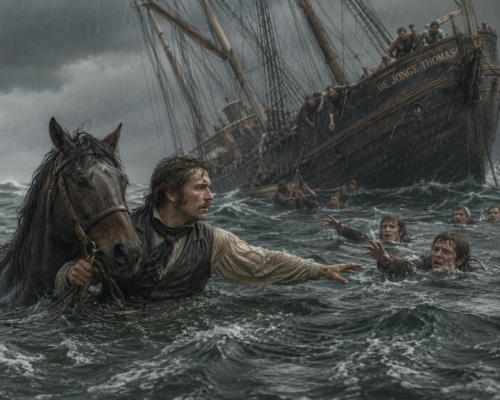
The rain had barely stopped falling across the Western Cape.
Through the past week the clouds had rolled low and dark over the mountains. The roads shone under standing water. Waves struck hard against the shore. Roofs rattled in the night. Rivers swelled brown and fast, and for many Capetonians sleep came lightly while winter battered windows and the sea roared beyond the city.
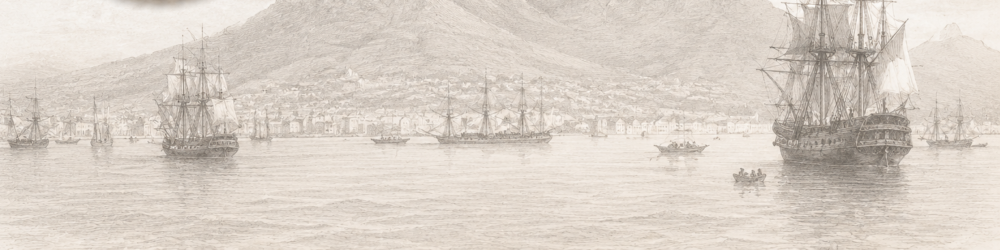
And while the storm moved across the province — as storms have always done here — history stirred again in Table Bay.
Because this was not the first winter the Cape had trembled under dark Atlantic skies.
More than two and a half centuries ago, on another bitter morning in early June, the sea rose in much the same way.
The wind arrived from the northwest before dawn on 1 June 1773. It tore through Table Bay with sudden violence. Rain drove across the water in sheets. The surf turned white with fury.
Anchored offshore lay the Dutch East India Company vessel De Jonge Thomas, already straining against her cables. Then came the breaking point. Her anchors gave way. The vessel was hurled toward shore. Wood splintered. Rigging snapped.
Within moments the ship had grounded near the mouth of the Salt River, caught between violent surf and a shoreline full of helpless witnesses.
Men clung to rails and wreckage. Others were swept overboard. Cannons were fired in distress. People gathered on the beach and watched in horror. The ship was close enough to see. Close enough to hear.
Yet impossibly far.
No boat could survive those breakers. No rope could reach.
And then a man came riding.
His name was Wolraad Woltemade. He was already past sixty. A farmer. A Cape resident. An ordinary man with no command, no uniform, and no duty placed upon him.
He saw the wreck. He saw the men trapped in the surf.
And without hesitation he rode his horse straight into the sea.
The breakers swallowed them. Horse and rider vanished into spray. For a long moment those onshore thought both had gone. Then they emerged.
Woltemade reached the wreck. Two sailors seized hold and he turned the horse back toward land. Through crashing surf and freezing water he brought them ashore.
Then he rode back. And again. And again.
Seven times.
Fourteen men were saved.
By then the sea had become a raging wall. The horse was exhausted. Woltemade himself could barely have had strength remaining. Still he turned once more toward the wreck.
But panic had overtaken the desperate men clinging there. Too many lunged at once. Hands grabbed for life. The horse lost footing. Rider and sailors disappeared beneath the waves.
And the sea kept them.
The next day Wolraad Woltemade’s body was found. Table Bay had claimed another life.
Yet Cape Town had gained something else — a story that would never leave.
Today, after another fierce spell of Western Cape weather, it feels strangely easy to imagine that morning. To picture clouds sweeping in over Lion’s Head. To hear the Atlantic striking hard against the coast. To feel the cold in the wind.
For all our forecasts and seawalls and modern warning systems, the Cape still knows winter storms exactly as it always has. The sea still rises. The rain still floods roads. The northwest still rattles windows and churns the bay.
Cape storms are no new thing. They are part of this coastline’s oldest memory.
But so too is resilience. So too is courage.
And every winter, when clouds gather over Table Mountain and Table Bay turns steel-grey beneath the wind, one can almost picture him there again —
a lone rider on the shoreline, the wreck in the surf, the gathered crowd standing helpless in the rain,
and Wolraad Woltemade urging his horse into the roaring sea.
The storms have never left the Cape.
Neither has the story.