
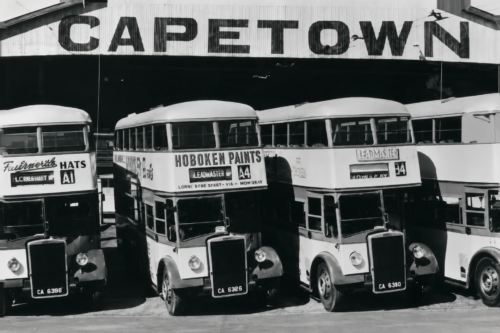
CAPE TOWN — The Cape Tramways group entered a new era of public transport during the early 1950s with the introduction of underfloor-engined, straight-framed Leyland Olympic and Worldmaster buses. While regarded as modern for their time, the vehicles soon proved less reliable than the conventional front-engined buses they were intended to replace.
Operators found that the underfloor engine layout was particularly vulnerable to the harsh operating conditions of the Cape. Dust and dirt from the region’s many unmade roads contaminated vital mechanical components, leading to excessive wear and significantly shorter intervals between major overhauls. Engineers later identified the now well-known problem of engine oil starvation as another major contributor to the vehicles’ disappointing performance.
Recognising these shortcomings, Cape Tramways returned to the proven front-engined Leyland range during the mid-1950s. The company ordered Leyland OPS4/5 single-deck buses together with 72-seat Leyland PD3A/2 and PD3/5 double-deckers, all featuring cranked chassis frames. The single-deck fleet carried locally built half-cab Busaf bodies, while the double-deckers were finished with modern full-front bodywork.
The fleet expanded again in 1966 and 1967 when 55 Daimler CVG6LX30 double-deck buses entered service. Mechanically almost identical to the Leyland PD3/5 models apart from their distinctive grille, thirteen of the Daimlers were initially allocated to Port Elizabeth before later returning to Cape Town in exchange for Fleetline buses.
Government Policy Changed Bus Design
A major turning point for the British bus industry arrived during the 1960s with the introduction of the United Kingdom’s Bus Grant scheme. The subsidy covered half the purchase price of new urban buses, provided passengers boarded through a door positioned beside the driver. The policy effectively ended production of conventional front-engined buses with cranked frames, leaving manufacturers to develop either straight-framed single-deckers or rear-engined double-deckers.
Guy Motors responded by redesigning its underfloor-engine concept into a new front-mounted configuration similar to the AEC Kudu. Marketed as the Guy Trambus, the engine was mounted ahead of the front axle, allowing the entrance door to be relocated beside the driver.
Cape Tramways purchased 40 Guy Trambuses in 1967, assigning fleet numbers 800 to 839 in Port Elizabeth. Cape Town also acquired several AEC Kudu buses before exchanging them with East London for more than 100 Leyland Worldmasters inherited from a previous operator. The Worldmasters, however, continued to struggle on the Cape’s steep and dusty routes.
From Guy to Leyland
The well-known Guy “Big J” was originally designed as a heavy truck rather than a passenger bus. In 1969 a heavier version of the Trambus chassis emerged as the Victory J. By this time Guy had become part of the expanding Leyland group, meaning Victory J buses were marketed under the Leyland name despite their Guy origins. Cape Tramways, together with operators such as United Transport, purchased large numbers of these robust vehicles during the following years.
Leyland’s acquisition of Guy and Daimler in 1968 further complicated bus identification. Although the Daimler Fleetline effectively became a Leyland product, the buses continued to carry Daimler badges. Many Fleetlines were powered by Leyland engines, but Cape Tramways specified the slower-running yet highly economical Gardner diesel. With the exception of a single demonstrator imported from Halifax in the United Kingdom, Busaf constructed the bodies for the fleet.
Rear Engines Proved Costly
Elsewhere, Johannesburg became the first operator to adopt Mercedes-Benz O305 buses with Busaf-designed double-deck bodies. Both Johannesburg and Pretoria had earlier experimented with Bristol VRT rear-engined double-deckers, while Pretoria’s first rear-engined fleet consisted of Leyland Atlanteans. Cape Town itself also evaluated a Leyland Atlantean demonstrator from 1960.
Cape Tramways’ own experience with rear-engined buses proved far less successful. Higher maintenance costs and operational difficulties prompted the company to investigate alternative solutions.
In 1973 Busaf, working closely with Cape Tramways, mounted an experimental double-deck body onto a Leyland Victory J chassis. The prototype, operating in Port Elizabeth as fleet number 1000, performed well enough to justify production orders for Cape Town’s new 16xx series. Four identical buses were later exported to Hong Kong.
Engineers subsequently discovered that the forward-mounted engine combined with the weight of the upper deck accelerated front tyre wear. Later production models in the 17xx and 18xx series addressed the issue by repositioning the front axle further forward.
Engineering Innovation Extended Fleet Life
One of the group’s most significant engineering achievements came during the early 1970s when Port Elizabeth Rolling Stock Engineer Mel Wright converted a Leyland Worldmaster by repositioning its horizontal engine into a vertical configuration.
The modification transformed the bus’s performance, bringing it close to that of the dependable OPS4/5 models, albeit with a slightly higher floor. Encouraged by the results, City Tramways in Cape Town rebuilt and re-bodied much of its Worldmaster fleet, extending the useful service life of the vehicles by well over a decade.
Cape Tramways also modernised many surviving OPS4/5 buses by moving the front axle rearwards, allowing the entrance door to be relocated beside the driver in a layout resembling the Guy Trambus. During rebuilding, the distinctive half-cab Busaf bodywork was replaced with contemporary full-front styling.
These refurbished buses found new life on the group’s country operations, serving communities including Stellenbosch, Strand, Paarl, Malmesbury, Saldanha and Worcester.
The final major chapter in this period of fleet development came in 1987 when Busaf supplied sixteen 100-seat double-deck buses built on Leyland Victory J chassis, marking the culmination of nearly four decades of continuous engineering evolution within the Cape Tramways group.
This article was rewritten from A Brief History of Cape Town Buses 1950-1980 by Rollo Dickson