
An Investigative Historical Feature
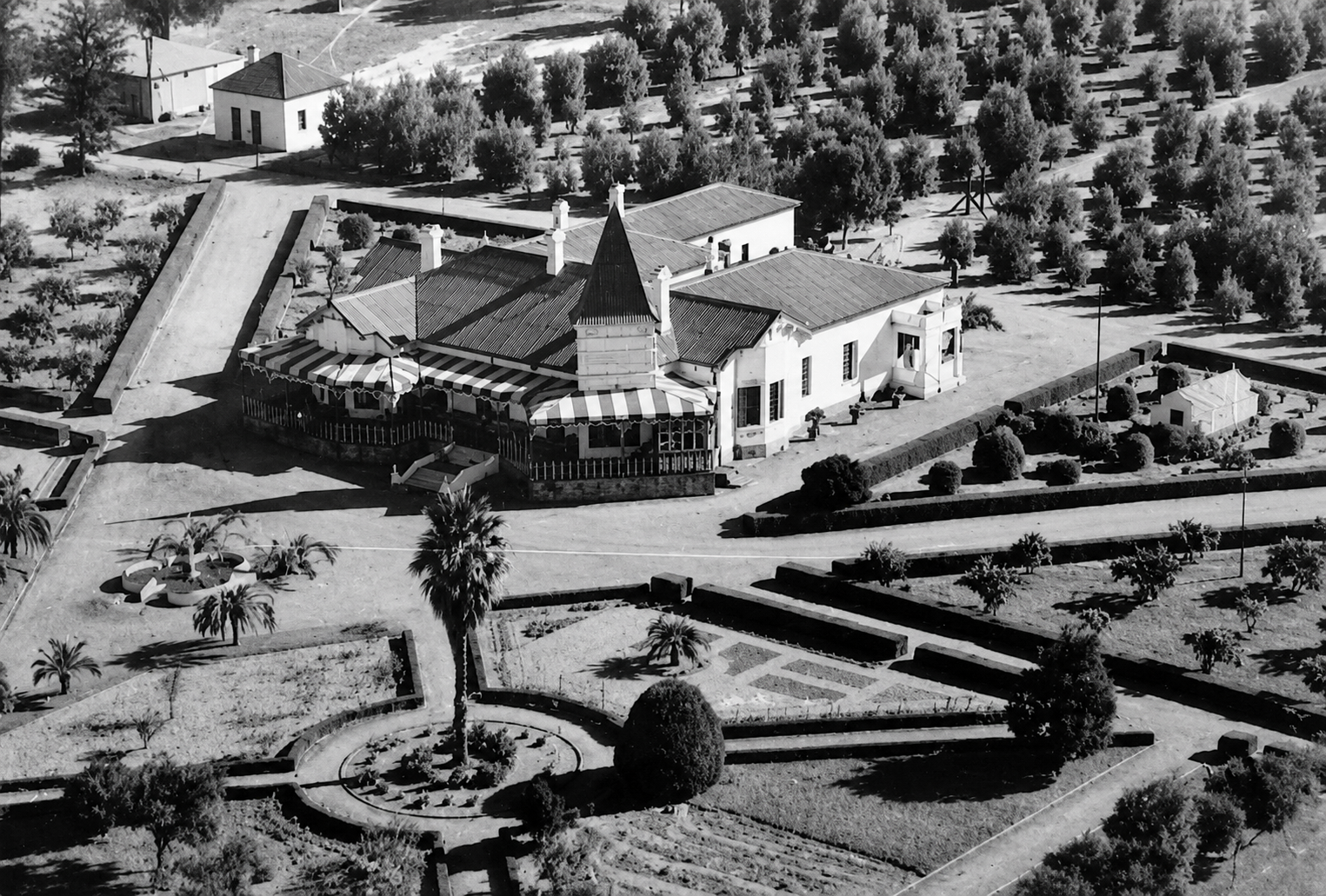
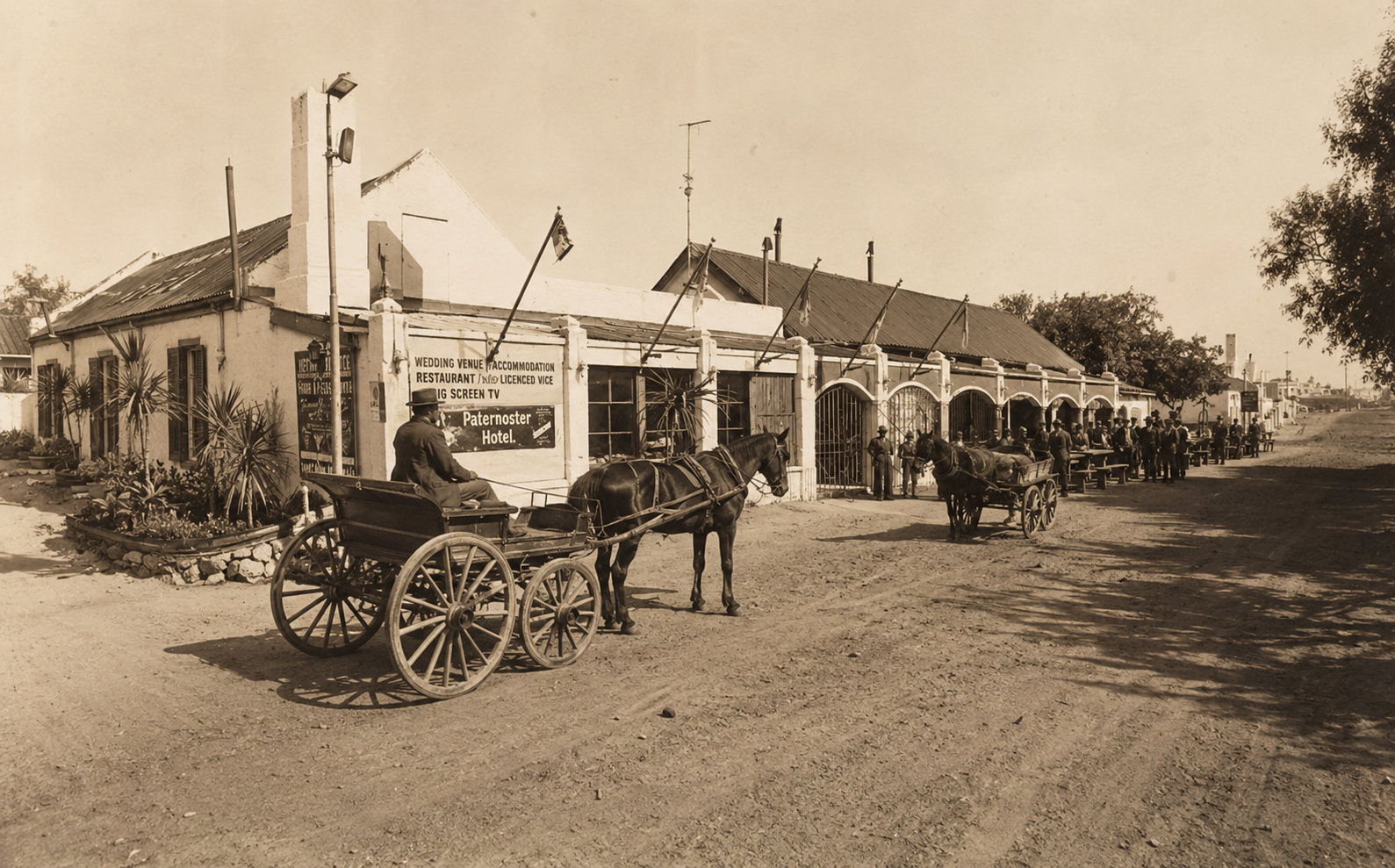
For generations, visitors arriving in the picturesque fishing village of Paternoster have been greeted by one of the West Coast’s most recognisable landmarks—the Paternoster Hotel. Whitewashed walls, thick limestone masonry and a windswept veranda evoke a bygone era when fishermen hauled their catches ashore and ox-wagons traversed the sandy tracks between isolated settlements.
The hotel’s published history is as charming as the village itself. According to the story repeated in brochures, guidebooks and on websites, the building was erected in 1863, the year Paternoster was established as a settlement. It is said to have served as the village’s general store, church, dance hall, lock-up and meeting place before being converted into a hotel in 1940. Today, that narrative forms an integral part of the hotel’s identity and of the heritage tourism that has made Paternoster famous.
But how much of this story can actually be proved?
The Cape Chronicle set out to investigate whether the celebrated origins of the Paternoster Hotel rest upon documentary evidence—or whether they have gradually evolved from oral tradition into accepted history.
A Story Told for Decades
The accepted narrative has remained remarkably consistent.
Local histories recount that the building was constructed from locally quarried limestone shortly after Paternoster was surveyed in 1863. In an isolated fishing settlement lacking civic infrastructure, one substantial building supposedly fulfilled numerous public functions. Church services were held beneath its roof. Community dances were staged in its hall. Produce from neighbouring farms was stored there before transport, while a small holding cell reportedly accommodated the occasional offender.
In 1940, the story continues, businessman Solomon Tollman purchased the building and transformed it into the Paternoster Hotel. Subsequent owners preserved the establishment until Johan and Wilna Carosini acquired it in 1973, ushering in the modern era of West Coast hospitality.
It is an attractive narrative.
It is also one that has seldom been critically examined.
The Search for Documentary Evidence
Professional historians distinguish between three forms of evidence:
- contemporary documentary records;
- physical or architectural evidence;
- oral tradition.
Ideally, all three support one another.
In the case of the Paternoster Hotel, however, the balance is less certain.
Recent heritage investigations undertaken during planning applications in Paternoster examined archival sources, title deeds and architectural characteristics in an effort to verify the building’s age. Those investigations concluded that researchers were unable to locate documentary evidence confirming that the existing structure was erected in 1863 or that every aspect of the traditional narrative could be independently verified.
That conclusion should not be misunderstood.
It does not establish that the story is false.
Rather, it highlights that the evidence presently available does not conclusively prove it.
For historians, absence of evidence is not evidence of absence—but neither is it proof.
Does the Building Look Like an 1863 Structure?
Architecture often tells its own story.
Specialists studying historic buildings consider construction methods, masonry techniques, roof structures, timber framing, window proportions and later alterations.
Several heritage specialists have observed that parts of the present Paternoster Hotel appear stylistically more consistent with construction undertaken during the late nineteenth or early twentieth century than with an untouched building dating from 1863.
One point frequently raised concerns the corrugated-iron roof.
Although corrugated iron had begun appearing in the Cape during the mid-nineteenth century, it was still relatively uncommon in remote coastal settlements during the early 1860s, where thatched roofs remained the norm.
This does not necessarily mean the building is younger.
Roofs are routinely replaced.
Walls are rebuilt.
Rooms are extended.
Many Cape buildings have evolved continuously over more than a century.
The question therefore becomes whether the existing hotel incorporates an earlier building or whether it largely represents later reconstruction.
Could Both Stories Be True?
Perhaps.
One of the most plausible explanations is that the site has indeed been occupied since 1863, while the building standing today reflects decades of rebuilding and alteration.
This phenomenon is common throughout the Cape.
A modest limestone structure erected during the nineteenth century may gradually have expanded as prosperity increased. New roofs replaced old thatch. Verandas were enclosed. Interior walls shifted. Additional rooms appeared.
After enough alterations, a building may remain historically authentic while containing relatively little of its original fabric.
Without detailed architectural investigation, determining precisely what survives from the earliest phase becomes extremely difficult.
The Village Before Tourism
Regardless of the precise construction date, there is little doubt that Paternoster itself possesses deep historical roots.
Fishing families occupied the coastline long before the village became formally established.
Throughout the nineteenth century, the settlement remained small, isolated and economically dependent upon the sea.
Public buildings were few.
Where permanent structures existed, they commonly fulfilled multiple roles.
Across rural South Africa, one building often functioned as church, school, courthouse and community hall depending upon the day of the week.
Consequently, the tradition that the Paternoster building served several community purposes is entirely plausible, even if the exact details remain difficult to document.
The Tollman Chapter
The first chapter that can be reconstructed with greater confidence begins during the twentieth century.
By 1940, the building had become a hotel under the ownership of Solomon Tollman.
This seemingly modest enterprise would later acquire unexpected international significance.
Members of the Tollman family eventually emigrated and built what became one of the world’s recognised luxury hotel groups, making the Paternoster Hotel an intriguing footnote in international hospitality history.
Ownership subsequently passed through several hands before Johan and Wilna Carosini purchased the property in 1973.
Under the Carosini family, the hotel became one of the defining institutions of the modern West Coast.
Ironically, the family’s stewardship also helped preserve the very historical narrative now being scrutinised.
Heritage and Marketing
Every historic destination faces the same challenge.
Visitors are attracted by stories.
Stories sell destinations.
But stories also evolve.
Sometimes they begin as family recollections.
Sometimes they emerge from local folklore.
Over decades they are repeated in newspaper articles, brochures, guidebooks and websites until repetition itself lends them authority.
This process rarely involves deliberate deception.
Instead, memory gradually hardens into accepted history.
The Paternoster Hotel appears to illustrate precisely this phenomenon.
Its traditional story may contain substantial truth.
It may also contain embellishments accumulated over generations.
Only careful archival research can distinguish one from the other.
Where the Answers May Lie
The mystery is far from unsolvable.
Several archival sources remain capable of providing definitive answers:
- original title deeds describing improvements on the property;
- Surveyor-General diagrams;
- valuation rolls recording buildings and alterations;
- probate records of early owners;
- municipal correspondence;
- early photographs;
- shipping records relating to building materials;
- contemporary newspaper reports describing public events at the premises.
Taken together, these records could establish whether the present hotel substantially dates from 1863, whether it occupies the site of an earlier structure, or whether the familiar date reflects an enduring local tradition rather than documented fact.
Why the Mystery Matters
Some may ask whether it makes any difference.
The answer is yes.
Heritage derives its strength from authenticity.
Authenticity does not require certainty.
Indeed, some of history’s most fascinating places are those where questions remain unanswered.
Understanding precisely when the Paternoster Hotel was built would enrich—not diminish—its significance.
If the building genuinely dates from 1863, documentary confirmation would strengthen one of the Cape’s most important heritage narratives.
If later research demonstrates that the present structure incorporates substantial rebuilding from a later period, that too forms part of its story.
Buildings evolve, just as communities do.
Historical truth need never compete with heritage.
The strongest heritage rests upon evidence.
The Verdict
After examining the available evidence, one conclusion becomes difficult to avoid.
The famous 1863 story cannot presently be regarded as fully proven historical fact.
Neither can it be dismissed as fiction.
Instead, it occupies the fascinating territory between documented history and inherited tradition.
The Paternoster Hotel almost certainly stands upon a site central to the early life of the village. Whether the walls visible today are those first raised in 1863—or the product of successive generations of rebuilding—remains one of the Cape West Coast’s most intriguing historical puzzles.
Until the deeds are examined, the photographs compared, the architectural fabric analysed and the archives fully explored, the question will remain open.
Perhaps that is fitting.
For every historic village deserves one enduring mystery, and few mysteries are as compelling as the one standing quietly at the heart of Paternoster—its whitewashed walls weathered by Atlantic winds, patiently waiting for history to reveal their true age.