
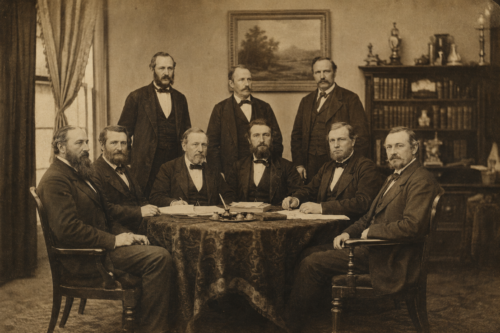
Paarl, Friday. — A gathering of gentlemen assembled this day at the residence of Mr. Gideon Malherbe in Paarl for the purpose of forming a society devoted to the advancement of the Afrikaans language. The association has assumed the title Genootskap van Regte Afrikaners (Society of True Afrikaners), and declares as its object the cultivation of the language spoken daily by a great portion of the inhabitants of this Colony.
For many years the common speech of the Cape has differed considerably from the formal Dutch employed in Government offices, schools, and churches. While many have dismissed this language as but a rustic dialect, the founders of the new society contend that it possesses a distinct character deserving of recognition and preservation. Their ambition is to establish Afrikaans not merely as a spoken tongue, but as a language fit for books, newspapers, education, and public discourse.
Among those concerned in the undertaking are the Reverend S. J. du Toit, Messrs. Gideon Malherbe, C. P. Hoogenhout, D. F. du Toit, known to many as “Oom Lokomotief,” together with several other gentlemen of the Paarl district. Their efforts have been inspired in no small measure by the observations of the schoolmaster Arnoldus Pannevis, who has long maintained that the language spoken throughout the Colony has become a tongue in its own right and ought to receive proper literary expression.
The Society proposes, with all convenient speed, to publish a periodical in the Afrikaans language, together with grammars, dictionaries, and other useful works intended to encourage reading and writing in the vernacular. Such publications, it is hoped, shall place the language within the reach of both the educated and the ordinary colonial reader. The proposed journal is expected to bear the title 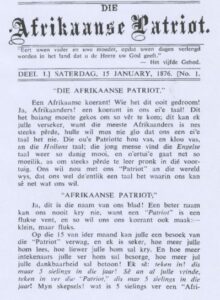 Die Afrikaanse Patriot, and will serve as the principal organ of the Society’s labours.
Opinion throughout the Colony is likely to prove divided. Some gentlemen continue to insist that proper Dutch alone is suitable for literature and public business, whilst others welcome the movement as a recognition of the language actually spoken in farmstead, village, and town alike. Whether this new endeavour shall prosper remains to be seen; yet few would deny that it marks an important chapter in the cultural history of South Africa.
Should the aspirations of the Society be fulfilled, future generations may look upon this modest meeting in Paarl as the beginning of a movement destined to give lasting form and dignity to the language of the Cape.